

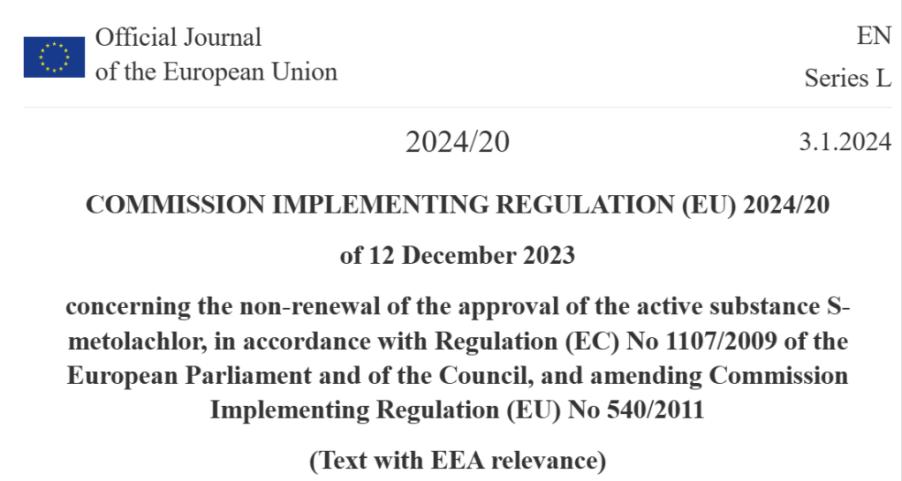
(Credit: Eur-Lex)
Material background
Prometolachlor is a chloroacetamide herbicide developed by Novartis (now Syngenta) that works by inhibiting cell growth by blocking the synthesis of ultra-long chain fatty acids. Metolachlor has a wide crop spectrum and is the main herbicide for corn and soybean fields, which are important food crops in the world.
As of the beginning of January 2024, there are a total of 24 original drug registrations and 62 preparation registrations in China, and preparation products are mainly used to control annual weeds. At present, spermatalachlor has been registered in the European Union, the United States, Canada, Australia and other countries and regions.
Eu review
In 2005, metolachlor was first approved by the European Union under the old Regulation on Plant Protection Products (Directive 91/414/EEC). After being included in the EU List of Approved Active Substances for Plant Protection Products (COMMISSION IMPLEMENTING REGULATION (EU) No 540/2011) the approval is valid until 31 July 2014. Due to the delay in the completion of the re-evaluation, the approval period for spermatalachlor has been repeatedly extended, most recently to November 15, 2024.
Back in February 2023, the European Food Safety Authority informed the European Commission of the results of its latest review on spermatalachlor, which mainly included the following risk points:
(1) According to the monitoring data, the content of spermatachloride and its related active metabolites in groundwater exceeded the limit value of 0.1μg/L, including metabolites with high suspicion of genotoxicity and carcinogenicity.
(2) There is a high risk of secondary toxicity for earthworm feeding mammals.
The European Commission invited applicants to submit comments on the findings of the review, but it did not dispel the EU's concern about the risk points of spermatalachlor. In this process, the French Agency for Food, Environment and Occupational Health and Safety (Anses) responded in February 2023, taking the lead in banning the main use of the herbicide in France, and the formal decision of the European Commission means that the EU level has finally decided that promealachalamine does not meet the approval criteria of the EU PPP Regulation for plant protection products. It was decided not to approve the active substance.
Buffer period
In accordance with Article 46 of Regulation 1107/2009, Member States shall be given sufficient time to withdraw the authorisation of the relevant plant protection products after the issuance of the decision, and an adequate marketing buffer period for plant protection products. Therefore, the decision states that EU Member States should withdraw the authorisation of plant protection products containing imeachlor by 23 April 2024, and that the marketing buffer period set by Member States should not exceed 23 July 2024.